

Leadership in the Fog: What the Dunkirk Evacuation Still Teaches Us About Crisis, Courage, and Collective Resolve

By Dr David Putnam
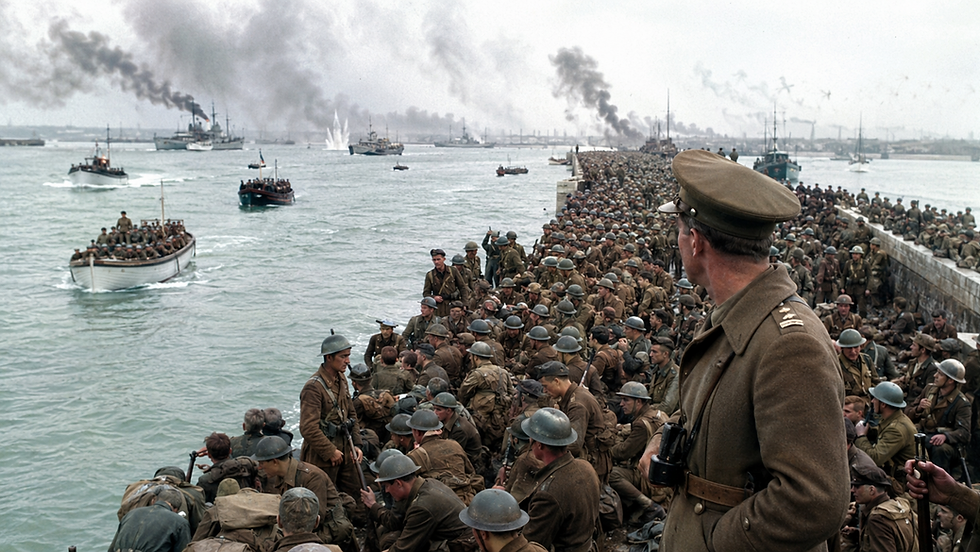
History has a way of circling back at the moments we need it most. Late May and early June mark the anniversary of one of the most improbable rescues in modern history—the Dunkirk evacuation of 1940. It was not a victory in the traditional sense. It was not a triumph of superior firepower or flawless planning. It was, instead, a triumph of leadership under pressure, of improvisation in the fog of crisis, and of ordinary people rising to extraordinary responsibility.
For leaders in government, corporate life, and public institutions, Dunkirk remains one of the clearest case studies in what it means to lead when the situation is collapsing faster than the plan can keep up.
1. Dunkirk Shows That Leadership Begins With Facing Reality—Not Denying It
By late May 1940, the British Expeditionary Force and its French and Belgian allies were cornered. The German advance had been faster, more coordinated, and more devastating than Allied planners believed possible. The situation was not “challenging.” It was catastrophic.
Winston Churchill, only weeks into his premiership, did not sugarcoat the moment. He named it. He faced it. And he forced his commanders and cabinet to confront the truth: the army might be lost unless something unprecedented was attempted.
Leaders today often feel pressure to project certainty, even when the data is grim. But Dunkirk reminds us that clarity is not pessimism. It is the first act of responsible leadership.
Leadership takeaway: You cannot solve a crisis you refuse to see. Reality is a leader’s ally, not their enemy.
2. When the Plan Fails, Leadership Must Pivot—Not Panic
The original Allied strategy had collapsed. Communications were fractured. Supply lines were severed. The evacuation plan—Operation Dynamo—was conceived in desperation, not confidence.
And yet, within days, the British Navy, civilian mariners, fishermen, ferry captains, and private boat owners mobilized a rescue fleet unlike anything the world had seen.
This was not improvisation born of chaos. It was improvisation born of adaptive leadership—the ability to pivot decisively when the environment changes faster than the strategy.
Leadership takeaway: In crisis, rigidity is fatal. Adaptation is survival.
3. Dunkirk Reveals the Power of Distributed Leadership
The evacuation succeeded not because of one heroic figure, but because thousands of individuals—naval officers, civilian captains, engineers, logisticians, medics, and volunteers—took initiative within their sphere of responsibility.
No one waited for perfect instructions. No one insisted on ideal conditions. No one demanded certainty before acting.
They understood something every modern leader must grasp: leadership is not a title; it is a response.
Leadership takeaway: Organizations thrive when leadership is distributed, not centralized. Empowered people save missions.
4. Morale Is a Strategic Asset, Not an Emotional Luxury
Churchill understood that the evacuation was not just a military operation—it was a psychological one. Britain needed hope, not illusion. The troops needed courage, not platitudes. The public needed honesty, not despair.
His famous words after the evacuation—“wars are not won by evacuations”—were not defeatist. They were grounding. He honored the miracle without pretending it was the end of the struggle.
Modern leaders often underestimate morale. But Dunkirk shows that morale is not sentiment. It is strategic oxygen.
Leadership takeaway: Hope must be truthful, not theatrical. Leaders sustain morale by telling the truth with courage.
5. Dunkirk Proves That Success Is Sometimes Measured by What You Save, Not What You Win
The evacuation rescued more than 338,000 soldiers—far beyond what planners believed possible. It preserved the core of the British Army. It kept the nation in the war. It bought time for rearmament, alliance-building, and strategic recalibration.
In leadership, not every outcome is a clean victory. Sometimes the win is survival. Sometimes the win is preserving capacity. Sometimes the win is simply living to fight another day.
Leadership takeaway: Success in crisis is not perfection. It is preservation of what matters most.
Why Dunkirk Still Speaks to Leaders Today
Whether you lead a government agency, a corporation, a university, or a public institution,
Dunkirk offers enduring lessons:
Face reality with courage.
Adapt faster than the crisis evolves.
Empower people at every level.
Guard morale as a strategic resource.
Redefine success when the environment demands it.
Dunkirk is not just a story of rescue. It is a story of leadership under fire—leadership that refused to surrender to despair, paralysis, or fatalism.
And in every era, including ours, that kind of leadership is still the difference between collapse and resilience.
Leadership Lessons from Dunkirk: What Crisis Reveals About Us
In late May 1940, the world watched an impossible situation unfold. Allied forces were cornered on the beaches of Dunkirk. The plan had collapsed. The enemy was advancing. The clock was running out.
And yet—over nine days—more than 338,000 soldiers were evacuated in one of the most improbable rescues in modern history.
Dunkirk isn’t just a military story. It’s a leadership story. One that still speaks to government leaders, executives, and anyone responsible for people in moments of pressure.
1. Leaders Must Face Reality Early
Churchill didn’t sugarcoat the crisis. He named it. He confronted it. He forced clarity when denial would have been easier.
Leadership insight: You can’t solve a crisis you refuse to see.
2. When the Plan Fails, Pivot—Don’t Panic
Operation Dynamo wasn’t born from confidence. It was born from necessity. The environment changed faster than the strategy, so the strategy changed.
Leadership insight: Adaptation is not optional. It’s survival.
3. Distributed Leadership Saves Missions
The evacuation succeeded because thousands took initiative—naval officers, civilian captains, engineers, volunteers. No one waited for perfect instructions.
Leadership insight: Empowered people outperform centralized control in every crisis.
4. Morale Is a Strategic Asset
Churchill told the truth without surrendering hope. He honored the moment without pretending it was victory.
Leadership insight: Hope must be honest. Morale is oxygen.
5. Sometimes Success Means Preserving What Matters
Dunkirk wasn’t a win. It was a rescue. But it preserved the army that would later win the war.
Leadership insight: In crisis, success is often measured by what you save, not what you gain.
Why It Matters Today
Whether you lead a government agency, a corporation, or a team navigating uncertainty, Dunkirk reminds us:
Face the facts.
Pivot fast.
Empower widely.
Guard morale.
Preserve what matters most.
Leadership isn’t proven in calm seas. It’s revealed in the fog.


Comments